Unraveling DMA Transfer Bottlenecks in Texture Streaming for Expansive Open World Environments
 Texture streaming in expansive open world environments depends on rapid data movement from storage devices to graphics hardware, and DMA transfers serve as the primary mechanism that bypasses CPU involvement to achieve this flow. Developers design these systems to load high-resolution textures on demand as players traverse vast landscapes, yet bottlenecks emerge when transfer rates fail to keep pace with rendering demands. Data from hardware monitoring tools shows that DMA queues can saturate under simultaneous asset requests, leading to visible pop-in or frame rate drops in titles that feature seamless world traversal. Researchers have mapped the core process where DMA engines handle block transfers of compressed texture data across PCIe lanes or system buses, and observers note that contention arises when multiple streams compete for limited bandwidth. In environments spanning dozens of square kilometers, texture atlases and mip chains multiply teh volume of required transfers, which stretches the capabilities of current DMA controllers. Studies from institutions like the Technical University of Munich indicate that latency spikes occur particularly during transitions between densely detailed regions, where prefetch algorithms struggle to predict player movement accurately enough to preload assets ahead of time.
Core Mechanisms Behind DMA in Texture Pipelines
Direct memory access operations allow storage controllers to push texture blocks straight into GPU-accessible memory without intermediate CPU buffering, and this approach reduces overhead in real-time applications. Engineers configure DMA descriptors to specify source addresses, destination buffers, and transfer sizes, enabling asynchronous execution that overlaps with rendering tasks. But here's the thing: when open world engines issue hundreds of small DMA requests per frame, the overhead from descriptor setup and interrupt handling begins to erode the theoretical gains in throughput.
Hardware vendors have introduced features such as PCIe peer-to-peer transfers and GPU-initiated DMA commands to streamline these operations further, while data indicates that effective utilization rarely exceeds 70 percent of peak bus capacity in complex scenes. Those who have analyzed frame captures from modern titles point out that fragmentation in the DMA command ring can cause head-of-line blocking, delaying critical high-priority texture loads behind less urgent background data.Identifying Transfer Bottlenecks in Large-Scale Worlds
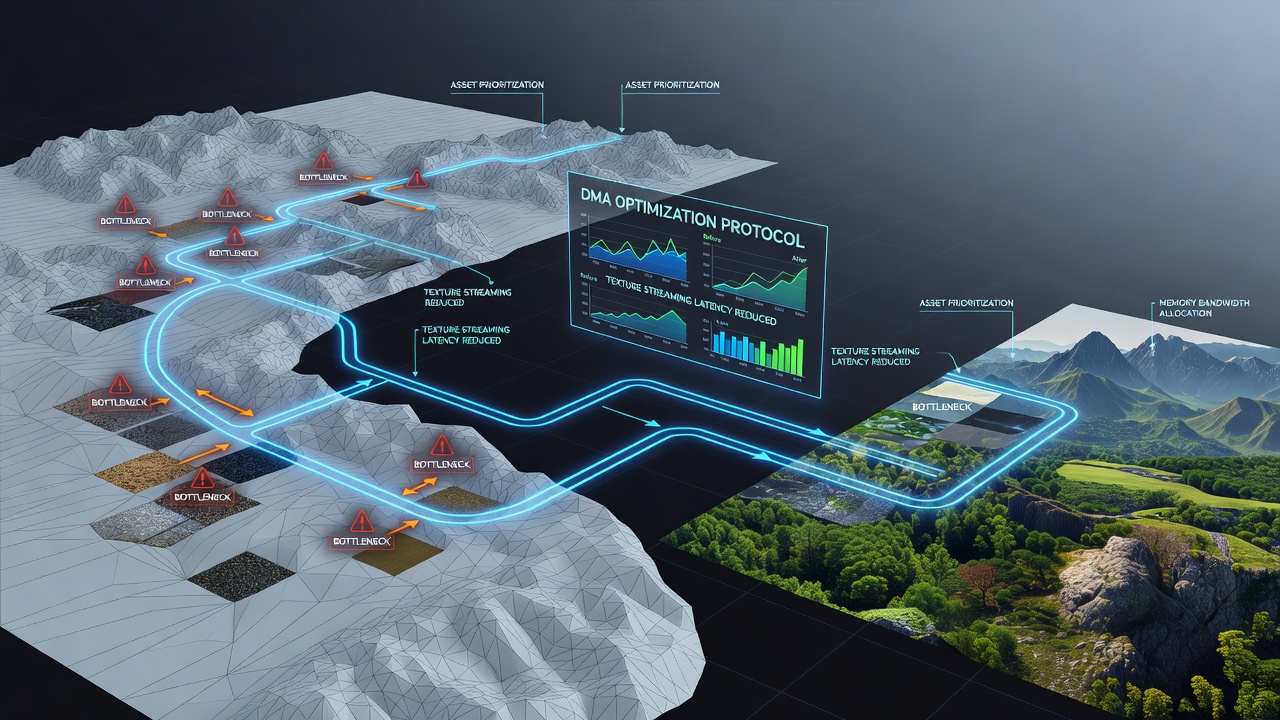
Bottlenecks manifest through several measurable patterns, including sustained bandwidth shortfalls and irregular completion times for DMA operations. In July 2026, reports from the European Games Technology Consortium highlighted how next-generation NVMe drives paired with updated DMA engines still encountered stalls when handling mixed workloads of 4K and 8K texture streams across expansive maps. Observers note that thermal throttling on storage controllers and cache misses in GPU memory management units compound these issues, forcing the system to fall back on slower fallback paths.
Figures from performance profiling suites reveal that DMA transfer times can vary by factors of three to five during peak exploration phases, and this variability disrupts the steady pacing required for consistent visual fidelity. Researchers discovered that inadequate queue depths in DMA controllers limit the number of outstanding transfers, which becomes problematic when games attempt to stream foliage, terrain, and building textures concurrently. What's interesting is how compression formats interact with these limits, since highly compressed blocks require more frequent small transfers that underutilize wide DMA channels designed for bulk operations.
Approaches to Reducing DMA Contention
Engineers address these constraints through techniques such as coalescing multiple small texture requests into larger DMA transactions and prioritizing transfers based on screen-space importance. According to documentation from the Khronos Group on modern graphics APIs, explicit DMA fencing mechanisms allow developers to synchronize texture availability with draw calls more precisely than legacy polling methods permitted. Data shows that implementing ring-buffer management with hardware-assisted scatter-gather lists can improve effective throughput by consolidating fragmented memory accesses.
Industry organizations including the Japan Electronics and Information Technology Industries Association have published guidelines on aligning DMA alignment boundaries with storage sector sizes, which minimizes partial transfers that waste bus cycles. Those who've studied this know that integrating predictive streaming models with DMA scheduling reduces the frequency of on-demand loads, although prediction errors still trigger corrective transfers that compete for remaining bandwidth. Solutions also involve partitioning DMA resources between foreground gameplay assets and background world simulation data to prevent one category from starving the other.
Hardware and Software Evolutions
Recent controller designs incorporate dedicated DMA engines per storage lane, and this distribution helps parallelize texture streaming across multiple devices in multi-drive configurations. Academic papers from the University of Sydney detail experiments where custom DMA firmware reduced average latency for 64-megabyte texture blocks by restructuring command ordering to favor contiguous physical addresses. Evidence suggests that pairing these improvements with adaptive compression ratios allows systems to trade minor visual quality for sustained transfer rates during intense exploration sequences.
Software layers now expose finer control over DMA priorities through extensions in graphics APIs, enabling titles to designate certain streams as latency-sensitive while deferring others. Figures reveal measurable reductions in frame time variance when these controls are tuned against real-world movement telemetry from playtests across diverse hardware setups.
Conclusion
Texture streaming in expansive open worlds continues to test the limits of DMA transfer efficiency as asset complexity grows, and ongoing refinements in both hardware queues and software scheduling provide pathways to smoother performance. Data from multiple monitoring initiatives demonstrates that addressing contention points yields consistent improvements in load predictability without requiring complete architectural overhauls. Continued collaboration between storage vendors, GPU designers, and engine developers supports incremental gains that keep pace with increasing world scales and visual expectations.