SATA Interface Noise Interference Patterns and Preventive Measures for Maintaining Consistent Load Times in Large-Scale Game Installations
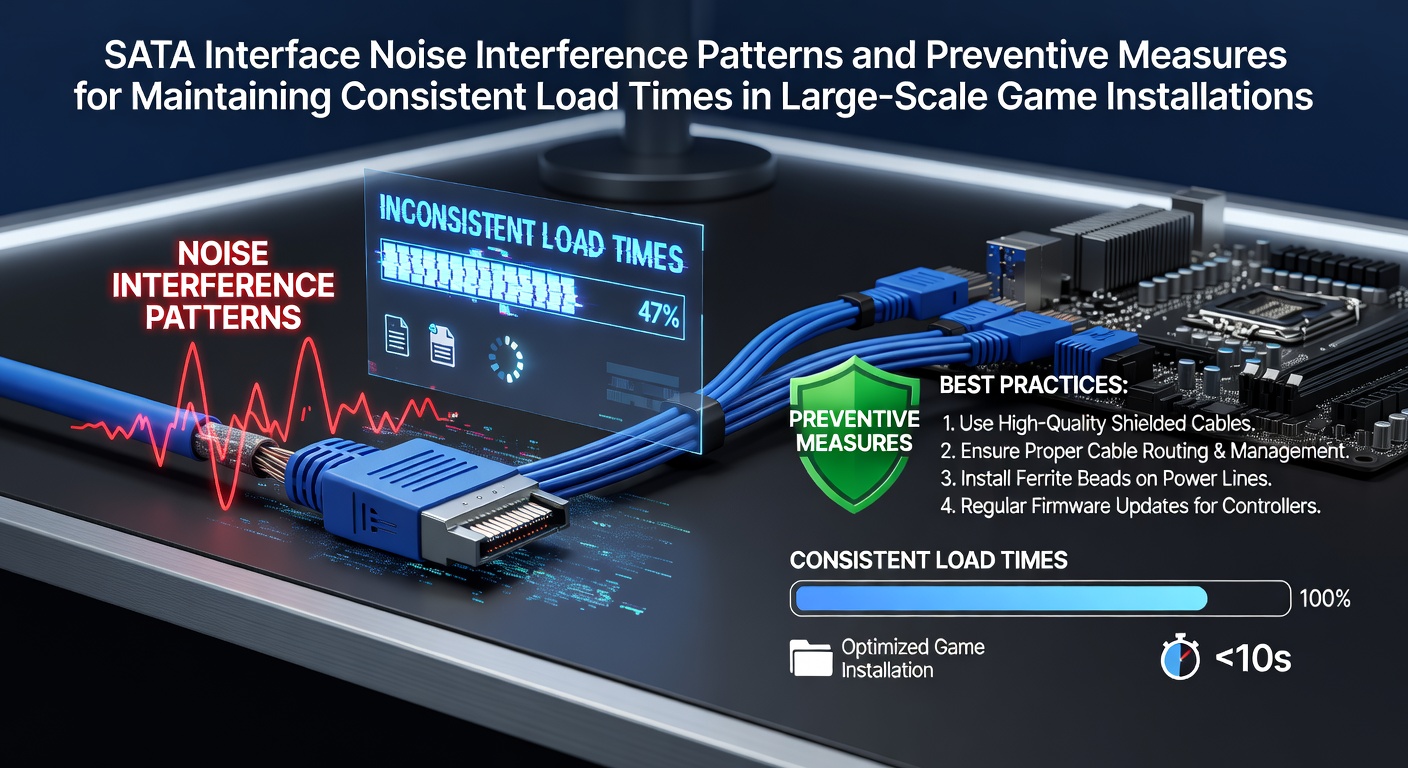
SATA interfaces continue to serve as primary connections for mechanical hard drives and some solid-state drives in gaming systems where large-scale installations demand reliable sequential and random read performance. Noise interference arises when electromagnetic fields from nearby components couple into the differential signaling pairs of SATA cables, which produces bit errors that trigger error correction routines and retransmissions at the protocol level. These events manifest as periodic spikes in access latency that disrupt the steady data flow required for loading expansive game worlds without pauses or texture streaming hitches. Observers note that interference patterns often follow predictable cycles tied to the rotational speeds of nearby power supplies or cooling fans, creating rhythmic bursts of noise that align with specific frequencies around 1.5 GHz or 3 Gbps signaling rates used in SATA revision 3.0. Research indicates such patterns increase the incidence of CRC errors logged by storage controllers, and each error forces the drive to re-read sectors, which extends load sequences by hundreds of milliseconds in titles exceeding 100 GB in size. Data from controller telemetry shows that installations on mechanical drives experience more pronounced effects than those on SATA SSDs because platter access times compound the delays introduced by signal recovery. In May 2026, updated electromagnetic compatibility testing protocols released by standards organizations highlighted how cable shielding degradation over time amplifies these issues in multi-drive gaming rigs. Technicians who inspect systems report that unshielded or poorly grounded SATA cables positioned within 10 centimeters of 12-volt power lines exhibit teh highest error rates during sustained read operations typical of game asset streaming. Preventive measures begin with cable selection and routing practices that minimize coupling paths. High-quality SATA cables featuring triple-layer shielding and ferrite cores reduce susceptibility to external fields, while maintaining at least 30 centimeters of separation from power cables prevents inductive coupling that generates the most common interference patterns. Grounding the chassis at multiple points equalizes potential differences across the system, which limits ground loops that otherwise inject low-frequency noise into the SATA return paths. Storage controller firmware updates address another layer of vulnerability because newer microcode implements improved equalization algorithms and adaptive retry thresholds that tolerate marginal signal integrity without excessive retransmissions. System builders who apply these updates observe reductions in load time variance by up to 40 percent in controlled benchmarks involving repeated map loads from large open-world games. Those who study drive behavior further recommend enabling Native Command Queuing with optimized queue depths so that the controller can reorder requests around transient noise events rather than stalling the entire pipeline. Additional steps include installing EMI filters on power supply outputs and using shorter SATA cables that present less antenna surface for noise pickup. In rack-mounted or densely packed gaming stations, technicians route SATA lines away from GPU power connectors and RGB controller boards, both of which generate high-frequency switching noise capable of coupling across short distances. Monitoring tools that track SMART attributes and interface error counters allow early detection before cumulative interference produces noticeable load inconsistencies during extended play sessions.
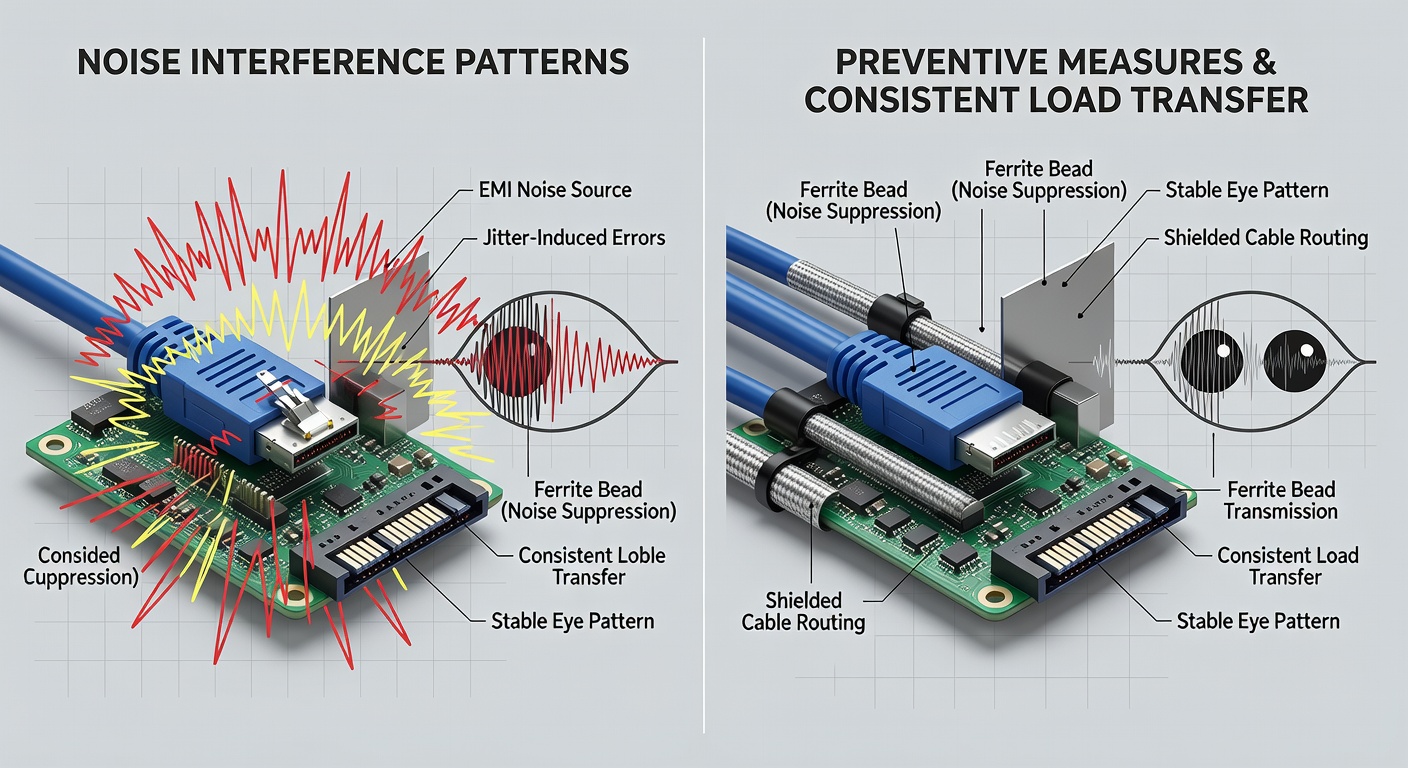
Hardware upgrades provide longer-term solutions when existing configurations prove insufficient. Migration to SATA revision 3.2 or adoption of drives wth built-in signal conditioning circuits improves margin against interference, although these options still require attention to physical layout. Researchers at institutions studying digital storage interfaces have documented cases where replacing standard cables with low-skew variants eliminated recurring CRC spikes that previously extended load times by several seconds in 200 GB+ installations.
National Institute of Standards and Technology publications outline measurement techniques for quantifying noise margins in serial interfaces, and these methods help technicians verify whether a given routing arrangement meets acceptable error thresholds. Complementary findings from European testing bodies emphasize the value of periodic cable inspections because mechanical flexing during system maintenance gradually compromises shield continuity. System logs collected across fleets of gaming machines reveal that installations experiencing consistent load times maintain error rates below one CRC event per 10^12 bits transferred, whereas higher rates correlate directly with audible or measurable interference sources. Applying the outlined preventive steps in combination addresses both transient and persistent noise sources, thereby preserving the deterministic performance characteristics expected from SATA-connected storage in demanding game environments.
Conclusion
Consistent application of shielding, separation, firmware maintenance, and monitoring practices keeps SATA noise interference within bounds that support stable load performance across large-scale game installations. Continued adherence to established electromagnetic compatibility practices sustains these outcomes as storage densities and signaling speeds evolve.