Router Bufferbloat Management Strategies for Smoother Online Matchmaking Experiences

Bufferbloat develops when network buffers in routers hold excessive data packets, which creates added latency and jitter during online sessions, and this problem surfaces frequently in multiplayer matchmaking where quick responses determine connection quality. Observers note that the issue stems from oversized buffers designed to handle burst traffic, yet they fail to release packets efficiently under sustained loads from gaming traffic.
Understanding Bufferbloat in Online Gaming Contexts
Data from network studies shows bufferbloat increases round-trip times from typical 20-50 milliseconds to over 200 milliseconds in affected connections, which disrupts the synchronization required for matchmaking servers to pair players without noticeable delays. Researchers discovered that gaming consoles and PCs generate consistent upstream traffic during lobby searches and match joins, which fills router queues and triggers the bloat effect when combined with background downloads or streaming services on the same network.
Those who've studied this know that the phenomenon affects both wired and wireless setups, although wireless connections compound the problem through additional interference factors that further delay packet transmission. Figures reveal that households with multiple devices experience bufferbloat more often because competing traffic streams compete for limited buffer space in consumer-grade routers.
Core Causes and Detection Methods
Bufferbloat arises primarily from default first-in-first-out queuing mechanisms in most home routers that prioritize volume over timeliness, and this leads to packets lingering in memory during peak usage periods common in evening gaming hours. Experts have observed that standard ISP-provided equipment often lacks advanced queuing disciplines, which allows latency to spike unpredictably when matchmaking requests coincide with other household internet activities.
Measurement tools such as the DSLReports speed test or Flent network tester help identify bufferbloat by comparing unloaded and loaded latency values, while researchers at various institutions have documented patterns where upload buffers contribute more to the issue than download ones in asymmetric connections typical of residential broadband.
Effective Management Approaches
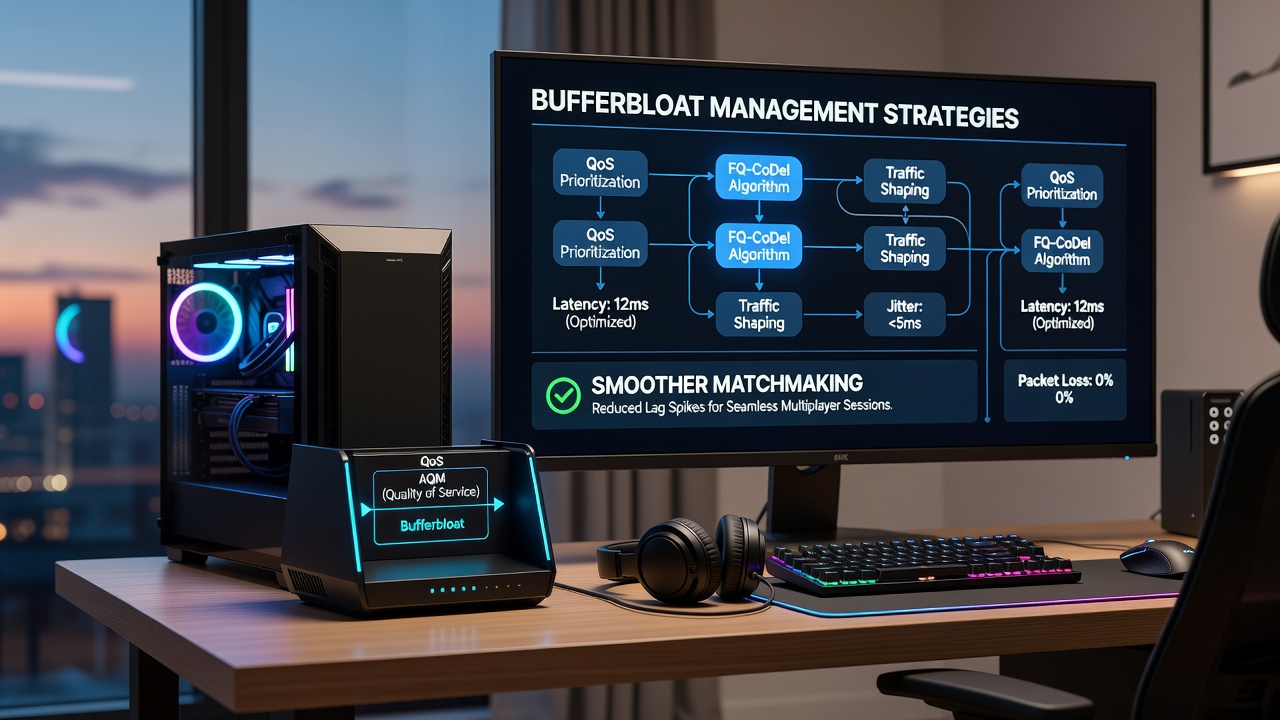
Active queue management algorithms like fq_codel and CAKE address bufferbloat by dynamically adjusting queue lengths and prioritizing low-latency traffic, and these methods work by dropping packets early when congestion builds rather than allowing buffers to grow unchecked. Data indicates that routers running OpenWRT or DD-WRT firmware with these algorithms installed reduce added latency to under 10 milliseconds even during heavy uploads, which supports smoother matchmaking experiences.
Quality of service configurations allow users to classify gaming traffic for preferential treatment, while those configurations require identification of specific ports or protocols used by matchmaking services. Industry reports from the Federal Communications Commission highlight how proper traffic shaping prevents one device from monopolizing buffer resources across shared networks.
Hardware upgrades to routers with multi-core processors and sufficient RAM enable more sophisticated queuing without performance drops, and observers note that models supporting these features handle simultaneous gaming sessions and video calls without introducing new delays. In June 2026, several manufacturers released firmware updates incorporating enhanced CAKE variants tuned specifically for real-time applications, which integrated feedback from global network testing initiatives.
Implementation Steps and Monitoring
Setup begins with replacing default firmware on compatible routers, followed by enabling SQM scripts that apply fair queuing across all connected devices, and this process typically takes under an hour for users following manufacturer guides. Continuous monitoring through built-in statistics or external dashboards tracks latency metrics over time, which reveals whether adjustments maintain low buffer occupancy during extended play sessions.
Academic sources including publications from European research networks demonstrate that combining these strategies with bandwidth limits set slightly below maximum connection speeds yields consistent results across varied ISP infrastructures. People often find that starting with conservative settings and gradually increasing limits prevents over-throttling that could otherwise affect matchmaking reliability.
Conclusion
Router bufferbloat management relies on targeted algorithm deployment, firmware modifications, and ongoing performance checks to keep latency stable for online matchmaking. Evidence from regulatory and academic sources confirms these approaches deliver measurable improvements in packet delivery timing across diverse network environments.