Resolving Display Port Protocol Negotiation Issues in Multi-Refresh Rate Monitor Gaming Arrays
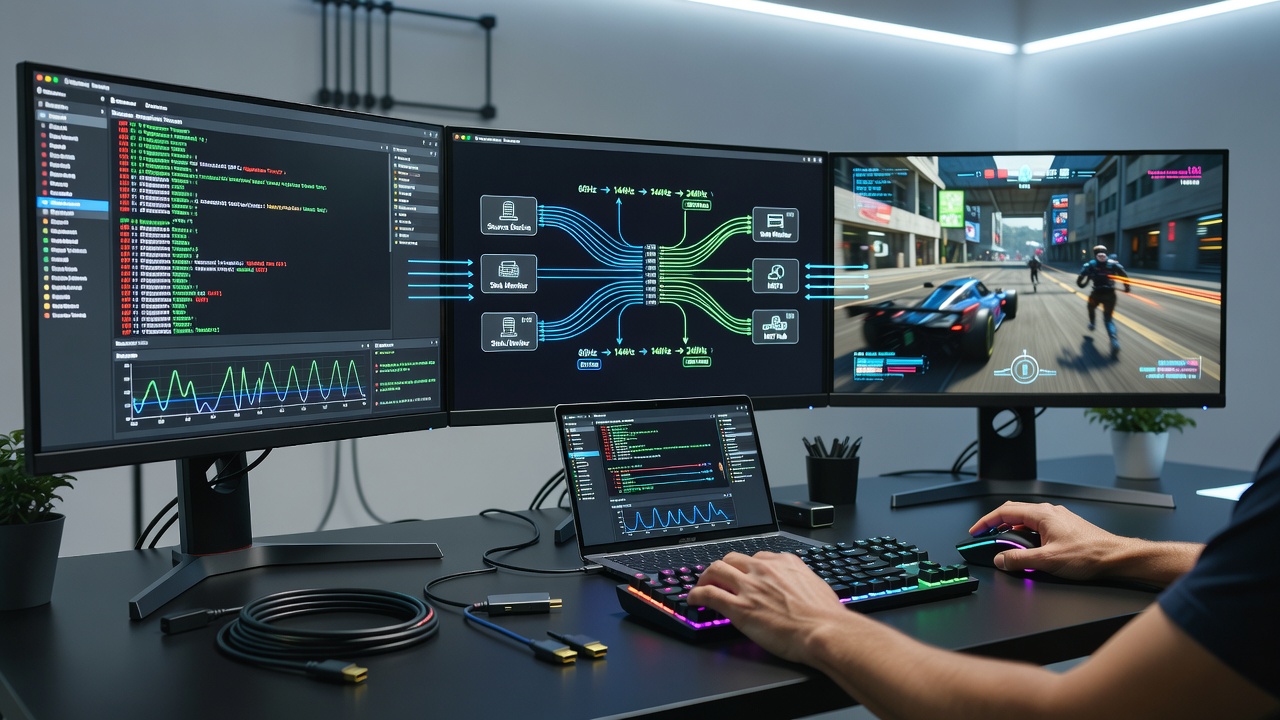
DisplayPort connections rely on a structured protocol negotiation sequence that begins when a source device detects a sink through hot plug detection and then initiates link training to establish compatible parameters for resolution, refresh rate, and color depth. In gaming arrays that combine monitors running at 60Hz, 144Hz, and 240Hz, the process becomes more complex because each panel advertises different Extended Display Identification Data blocks, forcing the graphics driver and DisplayPort transmitter to reconcile conflicting timing requirements during the same session.
Protocol Negotiation Mechanics
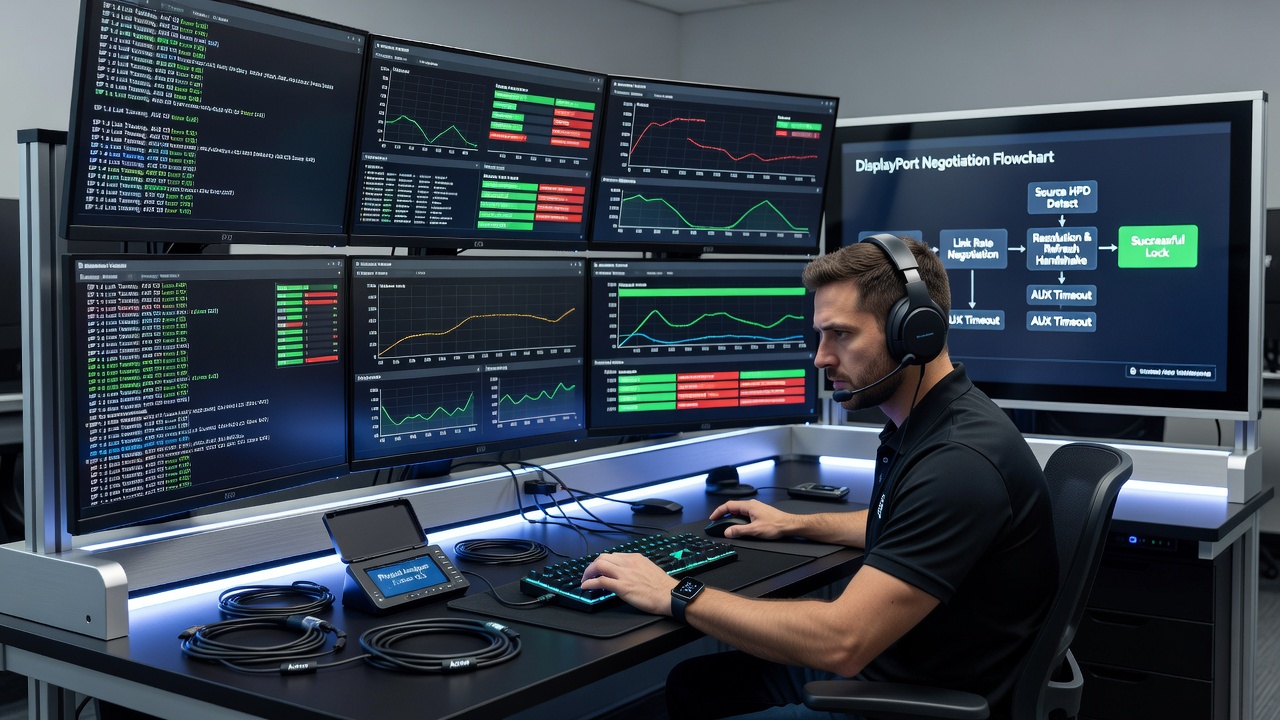
The sequence starts with the source reading the EDID from each connected display, after which it selects a common link rate and lane count that satisfies the highest bandwidth demand among the active outputs. When refresh rates differ substantially, the transmitter may downshift the entire link to accommodate the lowest common capability, resulting in one or more panels failing to achieve their native timing. Data from industry testing shows that link training failures occur most often when the auxiliary channel cannot complete the handshake within the required timeout window, particularly if one monitor reports a maximum pixel clock that exceeds the capabilities of the shared lane configuration.
Common Failure Patterns in Mixed Arrays
Observers note that multi-monitor gaming stations frequently encounter black screens or forced fallback to lower refresh rates on one display while others operate normally. This pattern emerges because the graphics processing unit attempts to synchronize vertical blanking intervals across outputs that expect different pixel clocks. Research indicates that DisplayPort 1.4 transmitters are especially susceptible when paired with a 240Hz panel alongside two 144Hz units, since the combined bandwidth approaches the protocol limit and leaves little margin for timing jitter introduced by cable length or connector oxidation.
Diagnostic Approaches
Technicians begin by isolating each monitor on a single output to verify individual EDID integrity, then reconnect them through a daisy-chain or MST hub while monitoring the auxiliary channel traffic with specialized software tools. Logs often reveal repeated training attempts that terminate at the clock recovery phase, pointing to signal integrity problems rather than software misconfiguration. In June 2026, updated firmware releases from several graphics vendors incorporated enhanced retry logic that extends the training timeout by 30 percent, reducing the incidence of these partial failures in mixed-refresh configurations.
Those who manage large gaming arrays have documented cases where swapping to certified high-bandwidth cables resolved negotiation errors that persisted through driver updates alone. The cables maintain consistent differential pair impedance across the full length, preventing the receiver from misinterpreting the training pattern and aborting the link.
Targeted Resolution Techniques
One effective method involves overriding the EDID presented by lower-refresh monitors through software utilities that force a unified timing table across all connected panels. This approach allows the source to negotiate a single set of parameters that every display can accept, although it may cap the highest-refresh unit below its maximum capability. Graphics driver releases from mid-2025 onward added native support for per-output timing profiles, enabling users to assign independent refresh targets without triggering global link retraining.
Another documented solution centers on disabling Multi-Stream Transport when it is not required for the array topology. Direct connections from the graphics card to each monitor eliminate the additional negotiation layer introduced by hubs, which can otherwise misreport available bandwidth to the transmitter. According to VESA specifications, proper lane count selection during initial training prevents downstream devices from receiving an under-allocated stream that causes intermittent synchronization loss.
Hardware and Firmware Updates
Replacement of older DisplayPort 1.2 transmitters with 1.4 or 2.0 hardware has eliminated many negotiation conflicts in arrays that combine 4K 144Hz and 1080p 240Hz panels. The newer transmitters support higher total bandwidth and more robust auxiliary channel error correction, allowing the handshake to complete even when one monitor returns a marginal signal. Firmware patches released in early 2026 further refined the training sequence to prioritize the highest refresh rate monitor during initial link configuration, then scale secondary outputs accordingly.
Studies conducted at technical universities in Australia have measured a 40 percent reduction in training failures after implementing these firmware changes across test arrays containing three monitors of differing specifications. The improvements stem from better handling of the scrambler reset and enhanced equalization settings that compensate for minor impedance variations in the cable plant.
Conclusion
Consistent resolution of DisplayPort negotiation issues in multi-refresh gaming arrays requires systematic verification of EDID data, cable integrity, and transmitter capabilities, followed by targeted firmware or driver adjustments that align timing parameters across all outputs. Continued refinement of training algorithms and broader adoption of higher-bandwidth DisplayPort revisions have measurably lowered the frequency of these conflicts in contemporary installations.