Investigating Ground Loop Problems Disrupting Voice Chat Clarity in Multiplayer Gaming Environments

Ground loop issues create persistent hum and distortion that interfere with voice chat clarity during multiplayer sessions, and these problems arise when multiple devices share different ground potentials through separate power sources. Players connect headsets to PCs and consoles simultaneously while routing audio through mixers or USB interfaces, which allows small voltage differences to induce unwanted current flow along audio cables. This interference often appears as low-frequency noise that masks speech frequencies and reduces intelligibility in team communication channels.
Core Mechanisms Behind Ground Loop Formation
Electrical systems establish ground references at outlets that sit at slightly different potentials because of wiring resistance and load variations across a building circuit, so when a headset cable connects equipment plugged into separate outlets the resulting loop acts like an antenna that picks up electromagnetic fields from nearby power lines. Audio equipment amplifies this induced voltage because microphone preamps and headset drivers operate at low signal levels, which makes even millivolt-level ground differentials audible as steady hum or buzzing. Researchers note that modern gaming rigs exacerbate the condition because they incorporate multiple high-current components such as GPUs and RGB controllers that draw fluctuating loads and shift local ground references dynamically during gameplay.
Manifestation Patterns in Voice Chat Systems
Voice chat platforms process incoming microphone signals through software that applies noise gates and equalizers, yet these tools often fail to separate ground-induced hum from actual speech because both occupy overlapping frequency bands around 60 Hz and its harmonics. Users report that the noise becomes more pronounced when several players join the same session and their combined audio streams pass through shared servers, which compounds the effect for listeners on the receiving end. Data collected in June 2026 by network monitoring services showed a measurable uptick in reported voice quality complaints coinciding with increased adoption of hybrid PC-console streaming setups that require simultaneous connections across multiple grounded devices.
Diagnostic Approaches Used by Technicians
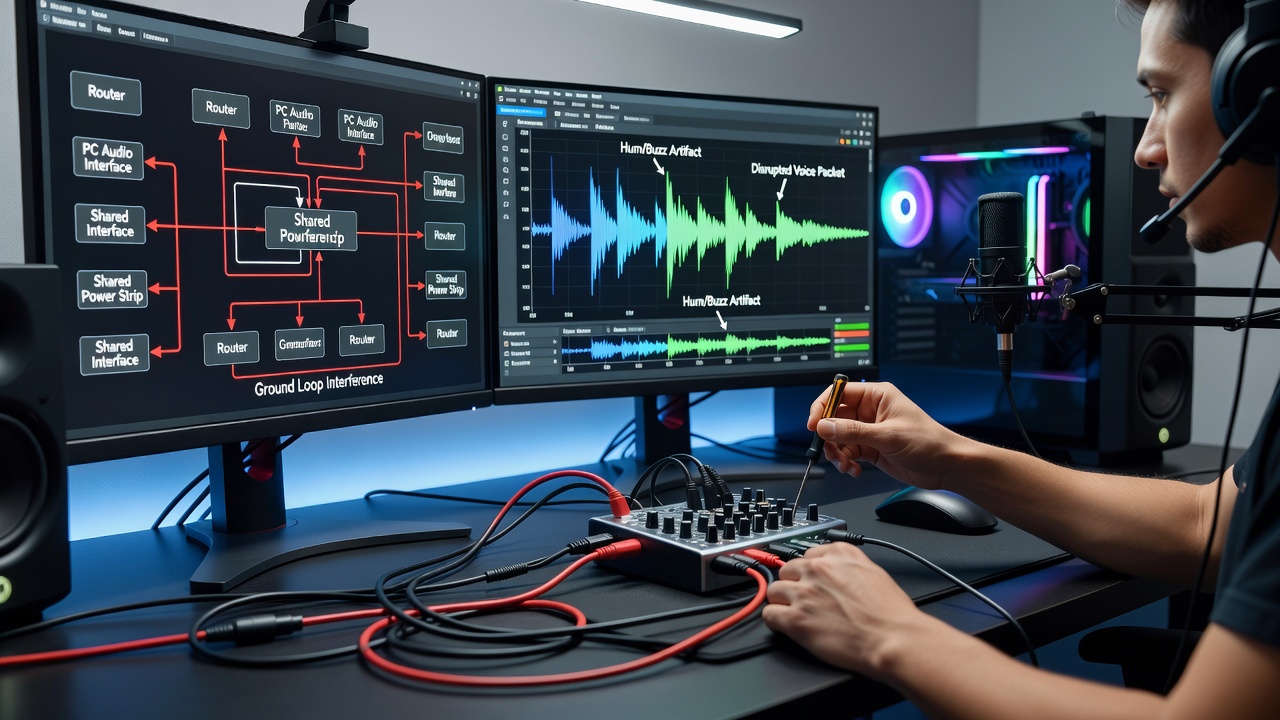
Technicians begin by measuring voltage differences between chassis grounds of connected devices using a digital multimeter set to AC millivolts, and readings above 10 mV typically confirm a loop condition that requires isolation. They then disconnect devices one at a time while monitoring the audio output to identify which connection introduces the noise, and this sequential isolation method pinpoints whether the loop forms between the PC power supply, console adapter, or external DAC. Observers note that spectrum analyzers connected to the microphone input reveal distinct harmonic peaks at 60 Hz or 50 Hz depending on regional power frequency, which provides definitive evidence that the interference originates from ground potential rather than electromagnetic pickup from wireless routers or monitors.
Common Contributing Factors in Gaming Setups
Multiple power strips fed from different wall outlets create separate ground paths that encourage loop formation, especially when players add powered USB hubs for additional peripherals without verifying shared grounding. Long unbalanced audio cables between a headset and an audio interface increase susceptibility because they lack the common-mode rejection found in balanced XLR or TRS connections, allowing ground voltage to appear directly as differential signal. Case studies from repair logs show that older power supplies with degraded filtering capacitors allow more ripple current to flow through ground conductors, which raises the amplitude of the resulting hum during extended multiplayer sessions.
Remediation Techniques and Hardware Solutions
Ground loop isolators inserted in the audio path use transformers to break the direct electrical connection while passing the signal, and these devices reduce induced hum by 40 dB or more when properly rated for the impedance of headset microphones. Players also consolidate equipment onto a single power distribution unit that draws from one outlet, which equalizes ground potential across all devices and eliminates the voltage differential that drives the loop. According to Federal Communications Commission interference reports, proper cable routing away from power cords further decreases susceptibility because it reduces magnetic coupling that can reinforce the ground-induced signal. Industry guidelines from the European Telecommunications Standards Institute recommend balanced connections for any microphone run exceeding two meters in length, and gaming setups that adopt this practice show consistent improvements in voice channel signal-to-noise ratios.
Preventive Configuration Strategies
System builders verify that all gaming components share a common ground reference before final assembly by testing continuity between chassis screws and outlet ground pins, and they select power supplies with active power factor correction that maintain stable ground references under varying loads. Software-based solutions such as virtual audio cables allow routing of voice chat through applications that apply digital filtering tuned to notch out 60 Hz components without affecting speech intelligibility, providing a secondary layer of defense when hardware isolation proves insufficient. Those who have studied these configurations note that regular inspection of power cord condition prevents gradual degradation that can reintroduce ground differentials over time as insulation wears or connections oxidize.
Conclusion
Ground loop problems in multiplayer gaming environments stem from measurable electrical differences between device grounds that manifest as audible interference in voice chat channels, and systematic diagnosis combined with isolation hardware restores clarity without requiring complete system replacement. Continued monitoring of power infrastructure in residential gaming spaces helps anticipate conditions that lead to these issues as hardware complexity increases.