Balancing PCIe Lane Allocation Quirks for Stable Multi-Drive Gaming Builds

PCIe lane allocation plays a central role in multi-drive gaming builds where several NVMe SSDs operate alongside high-bandwidth graphics cards. Modern platforms allocate lanes from the CPU and chipset, and adding drives can force sharing that reduces available bandwidth for each component. Data from hardware validation tests shows that configurations exceeding available lanes often experience negotiated speed drops from PCIe 4.0 x4 to x2 or lower on secondary storage devices.
PCIe Fundamentals in Gaming Systems
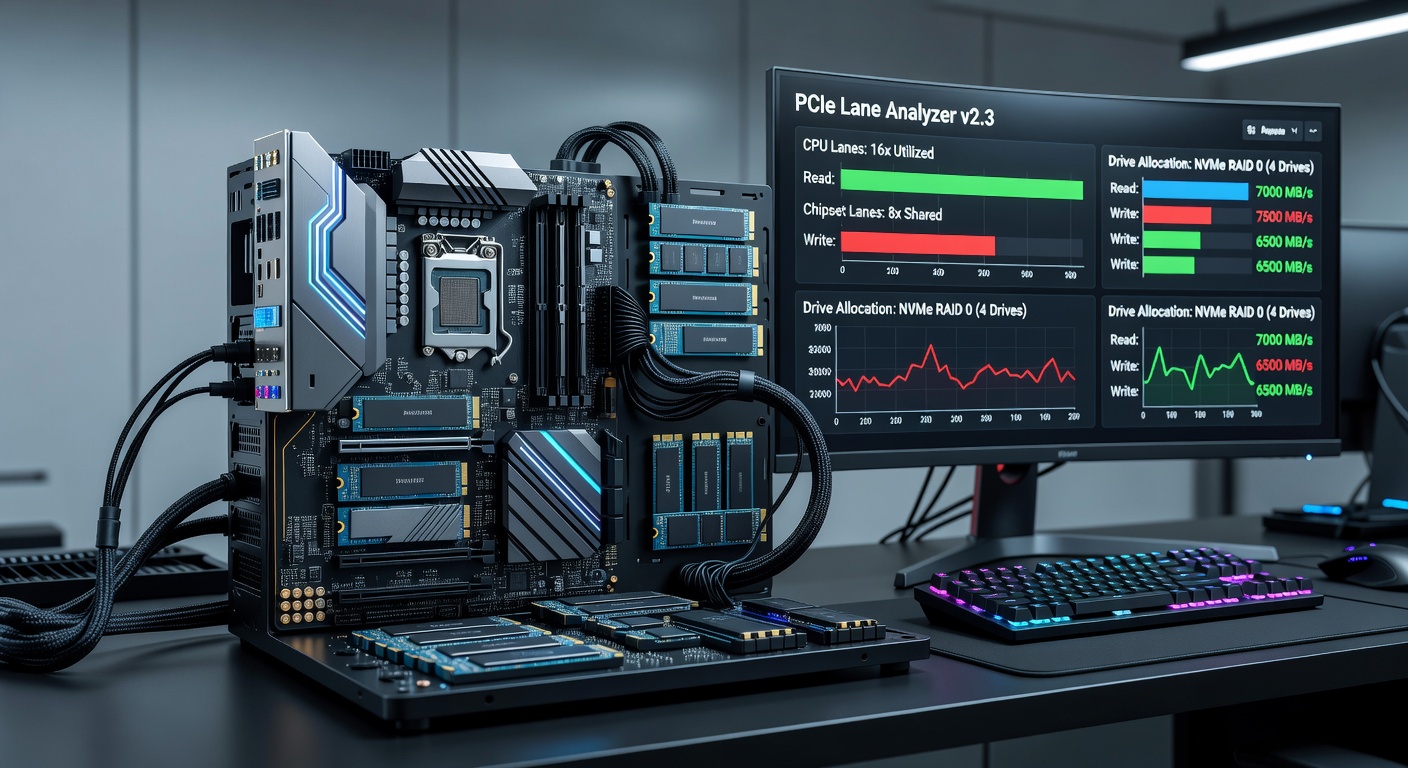
Processors from major vendors provide a fixed number of high-speed lanes while chipsets add supplementary ones through DMI or equivalent links. A typical setup routes 16 lanes to the primary GPU slot and four lanes per M.2 slot, yet additional drives connected through the chipset share a narrower uplink. Observers note that this division becomes noticeable once builders install three or more NVMe drives plus a dedicated graphics card.
Research from industry testing labs indicates that PCIe 5.0 platforms introduced in 2024 maintain backward compatibility, but lane negotiation still follows the same allocation rules. As of June 2026, early PCIe 6.0 motherboards have begun appearing in enthusiast channels, yet most gaming systems continue operating on 4.0 and 5.0 silicon where lane management remains critical.
Allocation Quirks Encountered in Practice
One common quirk arises when M.2 slots wired to the chipset contend for bandwidth during simultaneous game loading and texture streaming. Benchmarks compiled by storage vendors reveal throughput reductions of up to 45 percent on secondary drives when all lanes operate at peak. Another pattern appears with certain motherboards that automatically bifurcate CPU lanes, splitting a single x16 slot into two x8 connections for multi-GPU or GPU-plus-storage arrangements.
Take one documented case where a builder populated four Gen4 drives on a mid-range board; the fourth drive dropped to PCIe 3.0 speeds because the chipset uplink lacked sufficient capacity. Those who've studied these builds often discover that enabling RAID modes or certain storage controllers can further alter lane mapping, sometimes locking drives into lower generations until BIOS settings receive adjustment.
Strategies for Maintaining Stability
Builders achieve more consistent performance by selecting platforms with higher lane counts, such as workstation-oriented CPUs that supply 40 or more lanes. Charts published by AMD documentation outline exact lane distributions across Ryzen and Threadripper families, allowing planners to map drive placement before assembly. Chipset-level expanders provide another route; add-in cards using PLX or similar switches distribute lanes without taxing the primary CPU connections.
BIOS updates frequently refine lane training algorithms, and reports from European hardware certification bodies show measurable improvements in drive enumeration after such revisions. Disabling unused slots, setting explicit bifurcation values, and verifying link widths through tools like HWInfo help confirm that each drive receives its intended allocation. When multiple high-speed drives must share resources, staggering access patterns during gameplay reduces simultaneous bandwidth demand.
Studies conducted at technical universities in Australia highlight that thermal throttling on densely packed M.2 slots can compound lane limitations, because reduced signal integrity forces retraining at lower speeds. Proper spacing and heatsinks therefore form part of the allocation equation even though they do not alter lane counts directly.
Verification and Long-Term Maintenance
After initial setup, periodic checks with operating system utilities confirm that negotiated speeds match expectations. Logs from storage controllers sometimes flag fallback events that point to lane contention. Firmware revisions released by drive manufacturers address compatibility quirks that interact with specific lane configurations, and applying these updates maintains the stability achieved through careful allocation.
Figures from large-scale gaming hardware surveys indicate that systems configured with explicit lane mapping experience fewer random disconnect events across multi-drive arrays. Continued monitoring remains useful because future driver or BIOS changes can alter default behaviors without warning.
Conclusion
Effective PCIe lane balancing in multi-drive gaming builds relies on understanding platform limits, mapping drive placement to available resources, and applying firmware adjustments that preserve negotiated speeds. The patterns observed across current hardware show that proactive allocation prevents bandwidth bottlenecks before they affect load times or in-game asset streaming. Continued attention to BIOS updates and link verification sustains performance as new components enter the market.